
Types of Contact Lenses Explained
Daily, fortnightly, monthly, toric, multifocal: what the differences mean and which schedule suits your lifestyle.
Your contact lens prescription is not the same as your glasses prescription. Here is what each value means and why it matters before you order.
Many people assume their glasses prescription can be used to order contact lenses, but it cannot. A contact lens prescription includes additional measurements that ensure the lens fits correctly on the surface of your eye. Using a glasses prescription to order contact lenses risks wearing a lens with the wrong shape and diameter, which can cause discomfort and, in some cases, damage to the cornea.
Glasses sit several millimetres in front of the eye, while contact lenses sit directly on the cornea. This difference in distance changes the effective power required to achieve the same correction. More importantly, contact lenses must physically fit the shape and size of your eye. These are measurements that are irrelevant for glasses but critical for a safely fitting contact lens.
A contact lens prescription is issued following a contact lens fitting appointment, which is separate from a standard eye examination. In Australia, it is recommended that contact lens prescriptions are reviewed annually to confirm the fit remains correct and that your eyes remain healthy under lens wear.1
These two values do not appear on a glasses prescription. They describe the physical dimensions of the lens and ensure it sits correctly on your eye.
The curvature of the back surface of the lens, measured in millimetres. It must closely match the curvature of your cornea. A lens with the wrong base curve will not sit correctly. It may feel uncomfortable, move excessively, or cause the lens to sit too tightly against the eye, restricting oxygen flow. Typical values range from 8.3 to 9.0 mm.
Unique to contact lensesThe total width of the lens from edge to edge, measured in millimetres. The diameter determines how much of the eye surface the lens covers and contributes to centration and comfort. Most soft lenses have a diameter between 13.8 and 14.5 mm. This value is set by the manufacturer and matched by the optometrist to your eye size.
Unique to contact lensesThese values define the optical power of the lens and will also appear on your glasses prescription, though the contact lens values may differ slightly due to the vertex distance adjustment.
The primary vision correction power of the lens, measured in dioptres (D). A negative value corrects short-sightedness (myopia); a positive value corrects long-sightedness (hyperopia). This is the main correction value for most wearers. Example values: −2.50, +1.75.
All prescriptionsCylinder (CYL) is the additional power needed to correct astigmatism, and Axis is the orientation of that correction in degrees (0–180). These values only appear in prescriptions for wearers with astigmatism and are used to specify the correct toric lens. If your prescription has no CYL or Axis values, you do not have astigmatism requiring correction.
For astigmatism (toric lenses)The additional near-vision power required for wearers with presbyopia, which is the gradual loss of near focus that typically begins in your early 40s. The ADD value is used to prescribe multifocal contact lenses. It is expressed as a positive dioptre value and may also be indicated as Low, Mid, or High depending on the brand.
For presbyopia (multifocal lenses)When your prescription values are confirmed, you should be able to verify them against the lens box before ordering. Each box will display the key prescription parameters for that lens.
Confirm the brand and lens name match exactly what is written on your prescription. Different lenses from the same brand can have different base curves and diameters.
These are usually printed near the top of the box or on each individual blister pack. Confirm they match the values on your prescription exactly. Even a 0.1 mm difference in base curve can affect fit.
Check the power matches your prescription for each eye. Note that right (OD) and left (OS) eyes are often prescribed separately, so always order the correct values for each eye.
Every blister pack has a printed expiry date. Never wear a lens past its expiry. The sterility of the packaging cannot be guaranteed after this date.
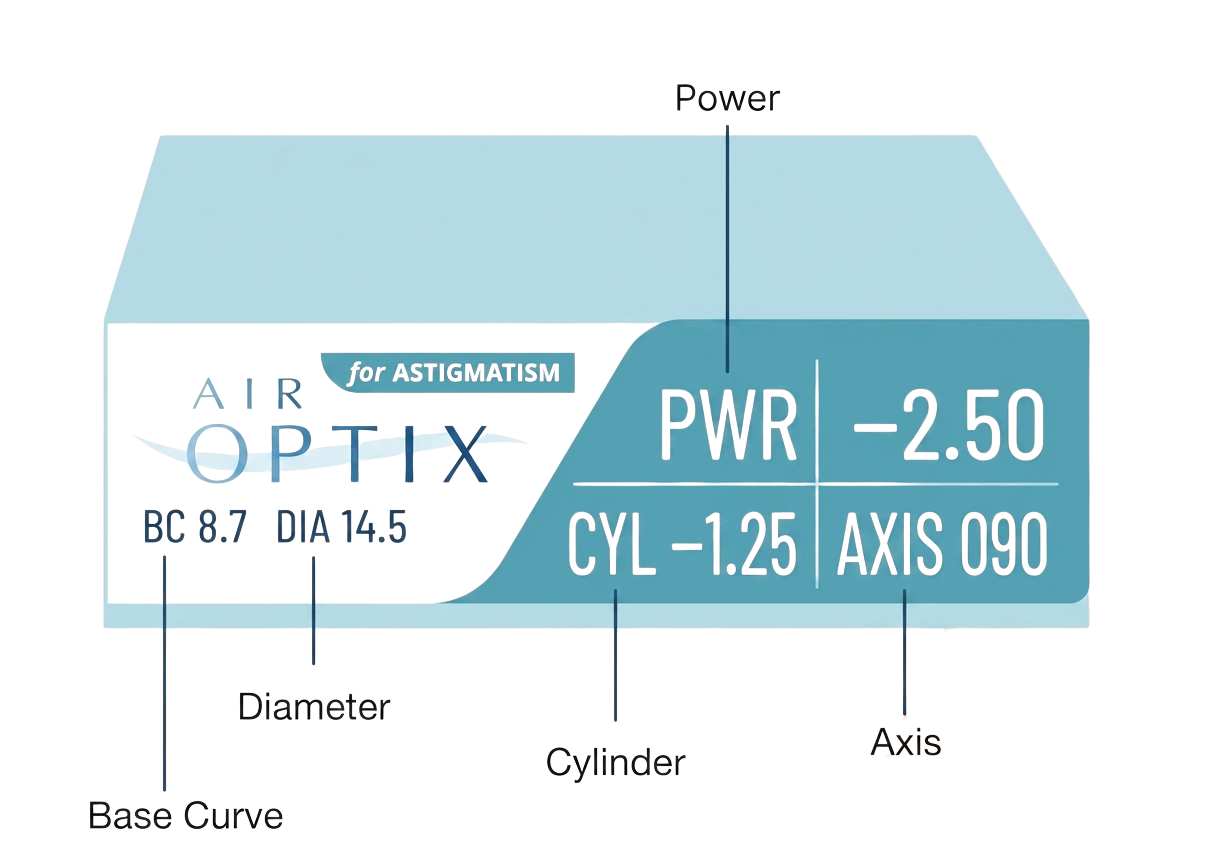
Only order the exact lens brand, BC, DIA, and power written on your current, valid prescription. If you are switching brands, visiting a new optometrist, or your prescription has changed, a new fitting must be completed before ordering.2
No. A glasses prescription cannot be used to order contact lenses. Contact lens prescriptions include base curve (BC) and diameter (DIA) values that do not appear on a glasses prescription. These measurements are essential for ensuring the lens fits the surface of your eye correctly. You need a separately issued contact lens prescription from your optometrist.
Contact lens prescriptions are typically valid for 12 months in Australia from the date of issue. After that, your optometrist needs to reassess your eye health and the fit of the lens before a new prescription can be issued. Some online retailers may ask you to confirm your prescription is current before completing an order.
If your prescription has no CYL (cylinder) or Axis value, it means you do not have astigmatism that requires optical correction. Your eyes have a regular corneal curvature, and a standard spherical lens (either daily, fortnightly, or monthly) is appropriate for your correction.
For higher prescriptions (typically above ±4.00 D), the power of a contact lens must be adjusted to account for the fact that it sits on the eye rather than at a distance from it. This adjustment is called vertex distance conversion. Your optometrist applies this calculation automatically. The value on your contact lens prescription is already the correct power for a lens worn on the eye.
Contact lens prescriptions must always be issued by a registered optometrist. Do not attempt to determine your own prescription values or order lenses based on another person's prescription.
Ready to order?
Browse our full range of daily, fortnightly, and monthly contact lenses, and order using your current prescription for fast Australia-wide delivery.